In this guide
Estimate block-laying mortar using joint geometry and a measured trial yield.
Identify the joint arrangement
Mortar demand depends on the actual block size, joint thickness, wall thickness and whether the specification requires full-bed or face-shell bedding. Hollow blocks can use different bedding arrangements. The example below assumes solid rectangular units with fully filled joints, solely to demonstrate geometry.
Calculate joint volume
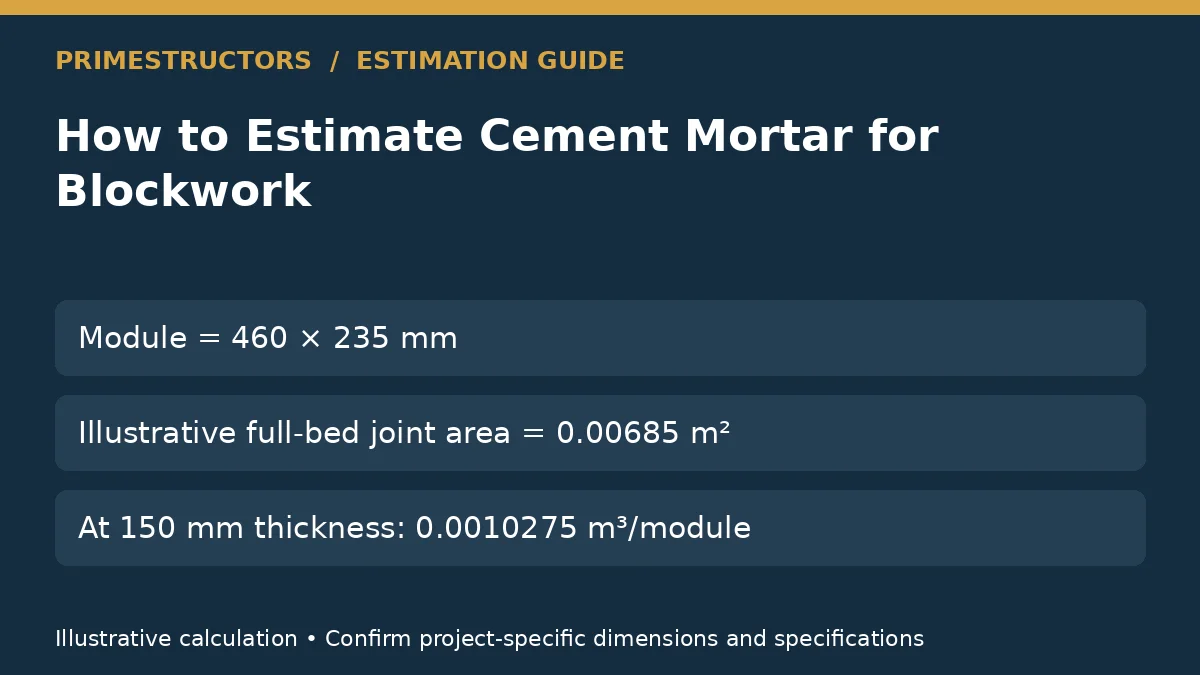
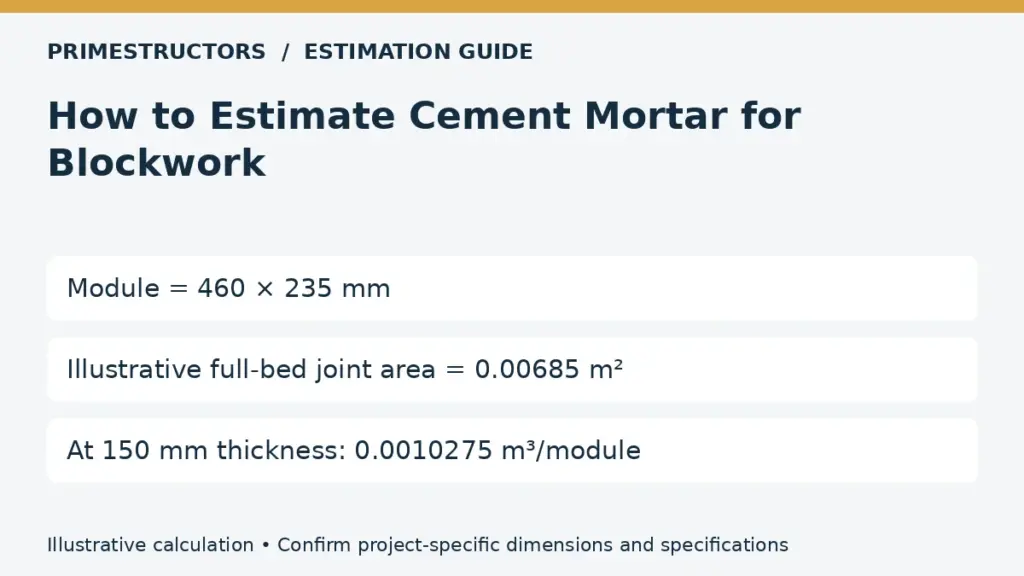
For a 450 × 225 mm face with 10 mm joints, the module area is 0.460 × 0.235 = 0.1081 m². The block face area is 0.450 × 0.225 = 0.10125 m². The difference is 0.00685 m². Multiply by a 0.150 m wall thickness to obtain 0.0010275 m³ per module. This method avoids counting the joint intersection twice.
Worked quantity example
For 30 m² of net wall, the module count is 30 ÷ 0.1081 = 277.52. The theoretical wet mortar is approximately 0.285 m³. An illustrative 10% allowance gives 0.314 m³. If a measured approved trial batch yields 0.08 m³, plan four batches. Convert those batches into cement and sand using the actual trial inputs.
Validate on site
Use a representative trial wall to compare actual consumption with the estimate. Record spillage, block absorption, bedding pattern and joint thickness. Do not assume that a full-bed calculation is appropriate for every hollow block. Follow the project specification for mortar strength and joint workmanship.
Measurement and procurement checklist
- Record dimensions, units and drawing revision.
- Keep net quantities separate from allowances and round only the final order.
- Confirm supplier coverage or trial yield before ordering.
- Record the date and basis of any supplier quotation.
For unit conversions, consult the NIST SI units reference. For project-specific requirements use the approved drawings, specifications and applicable local rules.