In this guide
Calculate compacted filling volume from measured areas and depths, then estimate loose delivery volume using verified project-specific compaction data.
Measure the fill zones
Sand filling is measured as a volume, not simply by the number of rooms. Identify the area requiring fill and the difference between the prepared formation and the specified top of compacted fill. Exclude concrete slab thickness, hardcore and other layers that are measured separately. Use levels taken on site and approved drawings.
Divide the building into zones where fill depth is reasonably uniform. For sloping ground, take a grid of levels and calculate representative average depths for each cell. A single depth taken near the entrance may underestimate the volume at the back of the building. Do not use this calculation to decide whether weak soil is suitable for construction.
Worked three-bedroom example
| Zone | Net area | Average fill depth | Compacted volume |
|---|---|---|---|
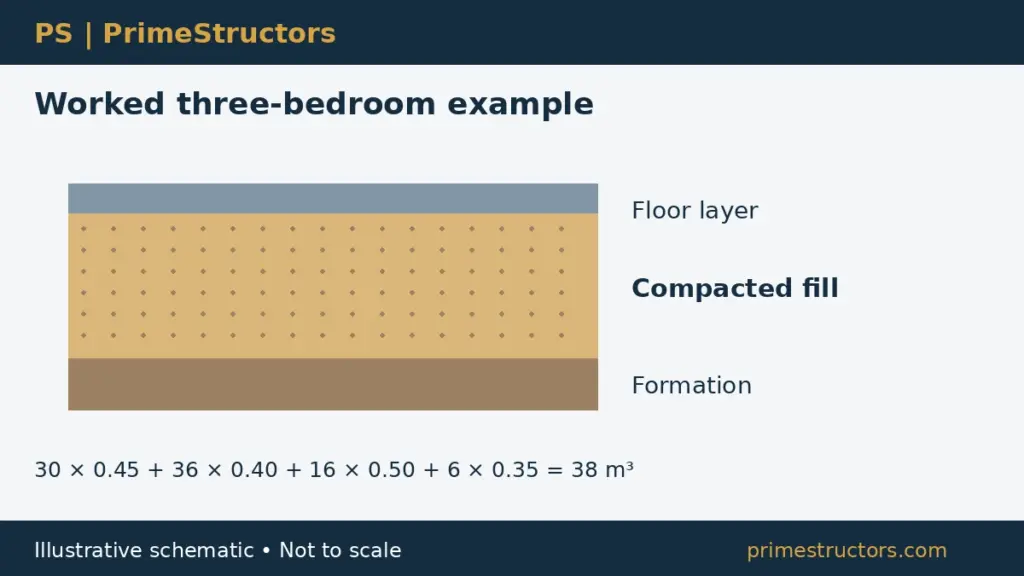
| Living and dining | 30 m² | 0.45 m | 13.50 m³ |
| Bedrooms | 36 m² | 0.40 m | 14.40 m³ |
| Kitchen and hall | 16 m² | 0.50 m | 8.00 m³ |
| Bathrooms | 6 m² | 0.35 m | 2.10 m³ |
| Total | 88 m² | Varies | 38.00 m³ |
Multiply each net area by its average depth and add the volumes. The example requires 38 m³ of compacted fill. These areas and depths are illustrative, not a building design. If internal foundation walls occupy part of the measured area, exclude their footprint unless the area is already measured clear between walls.
Convert compacted volume to delivery volume
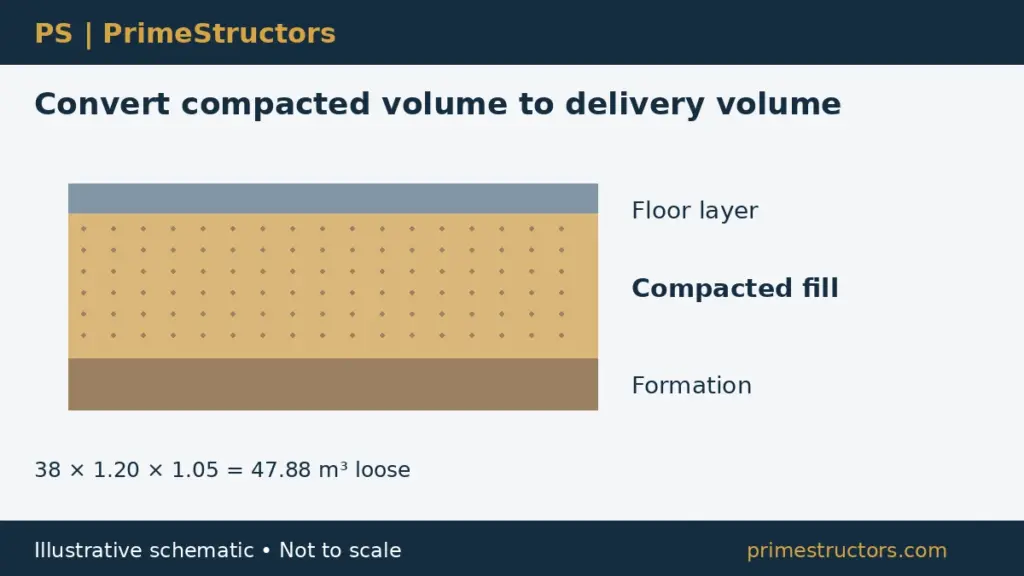
Loose delivered sand and compacted in-place fill are not interchangeable. Assume a site trial demonstrates that 1.20 m³ of loose material produces 1.00 m³ of accepted compacted fill. The loose requirement is 38 × 1.20 = 45.6 m³. If a further 5% delivery and handling allowance is justified, the order estimate becomes 47.88 m³. The factor and allowance are illustrative; actual values depend on material grading, moisture, density and placement.
For a verified usable truck capacity of 10 m³, round 47.88 ÷ 10 up to five trips. If capacity is 7 m³, round up to seven trips. Never assume all trucks described by the same local name carry identical quantities. Measure the load or obtain reliable weighbridge records and a suitable bulk density conversion.
Placement and compaction
Confirm that the proposed material is suitable under the project specification. Remove organic matter and unsuitable material as directed by the responsible professional. Place and compact fill in controlled layers using equipment appropriate to the material and confined space. Layer thickness, moisture conditioning and acceptance criteria must follow the project specification and site trial rather than a universal rule.
Protect buried services and foundation walls from damage. Do not fill over uninspected drainage or service installations. Where ground is soft, saturated or unstable, obtain geotechnical advice before proceeding; extra sand alone does not establish adequate bearing capacity.
Cost and delivery control
Request a quotation that states the actual delivered quantity, material type, source, transport distance and unloading arrangements. Multiply the number of trips by the delivered rate, and add spreading, compaction, testing and any separate plant charges. Record delivery tickets and measure the completed levels. Compare actual compacted yield against the trial factor and revise later orders accordingly.
A lower price per trip is not necessarily cheaper per accepted cubic metre. Compare the usable delivered volume and material suitability, not only the truck price. Avoid overloading vehicles or stockpiling against unsupported walls.
Frequently asked questions
How many trips are needed for a three-bedroom flat? There is no fixed number. Divide the verified loose requirement by actual truck capacity.
Can I use the same depth everywhere? Only when site levels justify it. Otherwise calculate by zones.
Is the loose-to-compacted factor always 1.20? No. Establish it through project-specific measurement and acceptance testing.