In this guide
Calculate paint litres from net surface area, product coverage, number of coats and pack sizes, with a room-by-room worked example.
Measure the surfaces
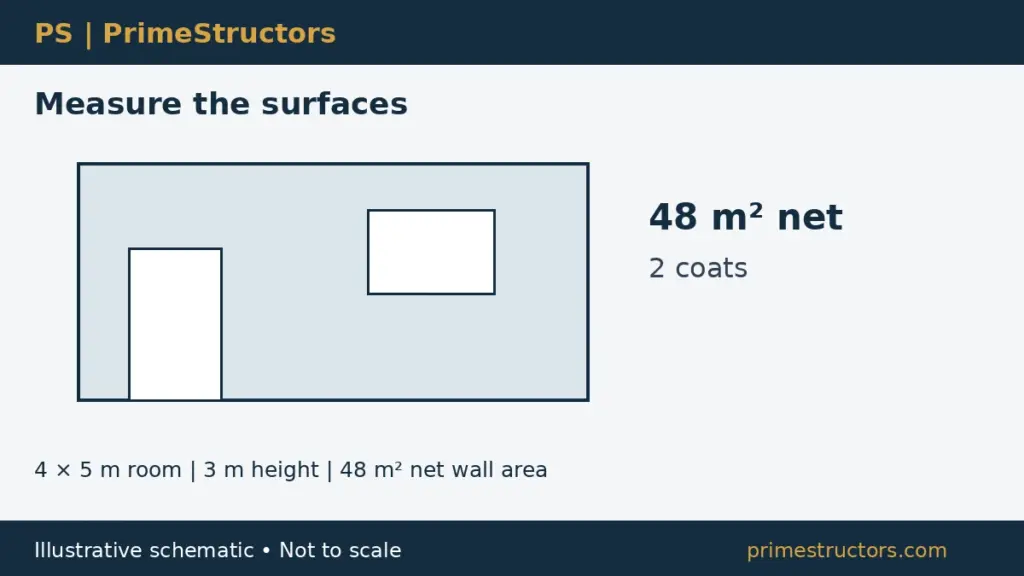
Measure the internal perimeter of each room and multiply by the painted height. Deduct doors, windows and surfaces receiving other finishes. Measure ceilings separately because ceiling paint may differ from wall paint. Record external walls separately, including gables and exposed returns. Do not assume floor area equals wall area.
A 4 × 5 m room with 3 m painted height has a perimeter of 18 m and gross wall area of 54 m². If openings total 6 m², the net wall area is 48 m². Measure reveals and recesses separately if they are to be painted.
Calculate litres and coats
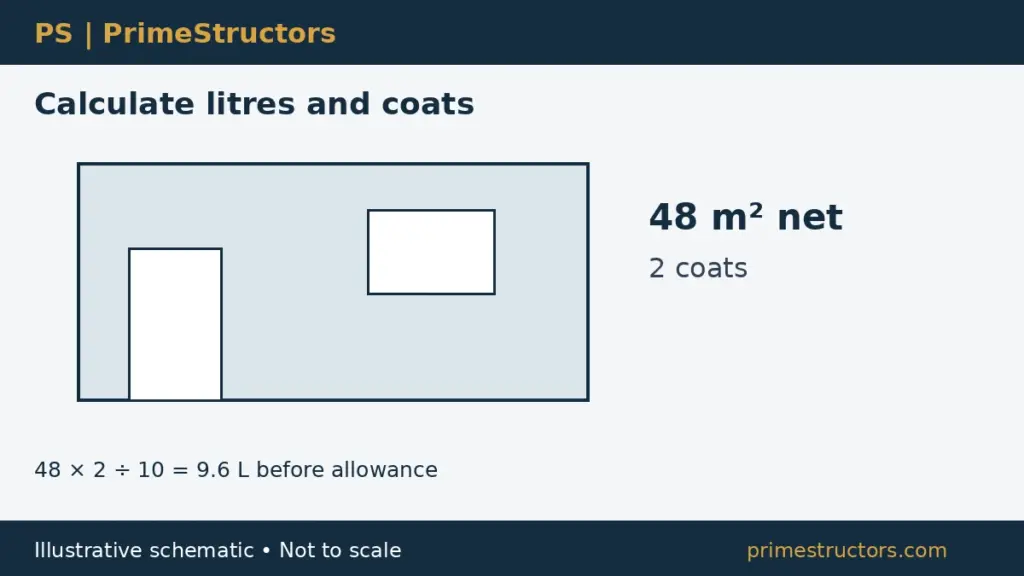
Divide net area multiplied by number of coats by the coverage stated on the product technical data sheet. At an assumed 10 m²/L per coat, 48 m² with two coats requires 9.6 L before allowance. Add an illustrative 10% for application losses: 10.56 L. If available packs are 4 L and 10 L, a 10 L plus 4 L purchase supplies 14 L; three 4 L packs supply 12 L. Compare actual pack prices and retain enough matching paint for touch-ups.
Coverage varies with substrate porosity, application method, colour change and product formulation. A rough or absorbent wall may consume more than a smooth sealed wall. Follow the manufacturer’s instructions for dilution, drying time and recoat interval. Do not assume adding water increases the specified dry film coverage.
Worked apartment schedule
| Room | Net wall area | Two coats at 10 m²/L |
|---|---|---|
| Living room | 48 m² | 9.6 L |
| Bedroom 1 | 40 m² | 8 L |
| Bedroom 2 | 36 m² | 7.2 L |
| Bedroom 3 | 36 m² | 7.2 L |
| Kitchen painted area | 20 m² | 4 L |
| Hall | 20 m² | 4 L |
| Total | 200 m² | 40 L |
With 10% allowance the wall paint requirement is 44 L. If all rooms use the same product and colour, five 10 L packs provide 50 L. If colours differ, calculate and round each colour separately. Assume ceilings total 80 m², two coats and 12 m²/L coverage: 13.33 L before allowance, or 14.67 L with 10%. Ceiling paint is a separate purchase.
Primer and surface preparation
Primer or sealer is a separate product with its own coverage. For the 200 m² wall area, an illustrative one-coat primer at 8 m²/L requires 25 L before losses, or 27.5 L with 10% allowance. Do not include primer litres in the finish paint total. Confirm the compatible system with the manufacturer.
Investigate dampness, loose plaster, efflorescence and existing coating failure before painting. Repair the cause of moisture rather than concealing it with paint. Check the product requirements for substrate moisture, curing, ventilation and preparation. Include filler, sanding materials, masking and protective sheets in the estimate.
Build the cost estimate
Obtain quotations for each product, pack size and colour. Multiply the pack count by the quoted pack rate, then add primer, preparation materials, labour, access equipment and transport where applicable. A quotation should state whether surface repairs and protection of furniture are included. Record the supplier, date, location and tax treatment. Do not use an old online price as a current quotation.
Frequently asked questions
Is one coat enough? Follow the specified coating system and inspect coverage; colour changes may require additional coats.
Can I combine different paint colours in one calculation? Only for a preliminary volume total. Procurement requires separate pack rounding.
Why did my estimate differ from actual use? Check substrate condition, coverage assumptions, losses and the actual painted area. Record consumption on a trial area before ordering a large quantity.